
This article has been disseminated on behalf of LaFleur Minerals Inc. and may include a paid advertisement.
MiningNewsWire Editorial Coverage: Gold prices have climbed to record or near-record levels in recent months as inflation worries, geopolitical tensions and strong purchases by central banks continue to fuel investor interest in the precious metal. Several major financial institutions have lifted their outlooks for the precious yellow metal, with some analysts projecting considerably higher prices over the coming years as global debt expands and economic uncertainty persists. In this environment, gold developers and smaller producers are working to strengthen their asset portfolios and move projects forward that could benefit from favorable market conditions. One such company is LaFleur Minerals Inc. (CSE: LFLR) (OTCQB: LFLRF) (Profile), which has recently taken multiple steps to strengthen its position within Québec’s well-known Abitibi Gold Belt and progress towards gold pour this year. The company announced a favorable Preliminary Economic Assessment (“PEA”) for its Swanson Gold Project, released drilling results that support the deposit’s expansion potential and continued progressing with refurbishment work at the fully permitted Beacon Gold Mill. Together, these developments illustrate LaFleur’s strategy of pairing exploration growth with existing infrastructure as it works toward restarting production and building a stronger presence in an increasingly robust gold market. LaFleur operates alongside a number of established gold-sector players, including Snowline Gold Corp. (TSX: SGD) (OTCQB: SNWGF), Radisson Mining Resources Inc. (TSX.V: RDS) (OTCQX: RMRDF), Maple Gold Mines Ltd. (TSX.V: MGM) (OTCQX: MGMLF) and Kinross Gold Corp. (TSX: K) (NYSE: KGC).
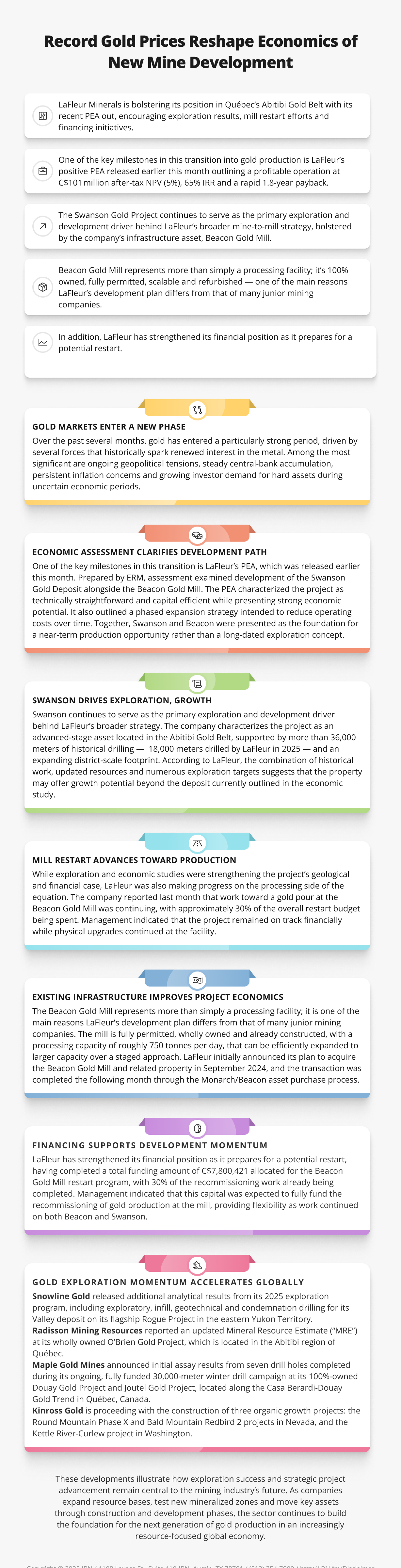
- LaFleur Minerals is bolstering its position in Québec’s Abitibi Gold Belt with its recent PEA out, encouraging exploration results, mill restart efforts and financing initiatives.
- One of the key milestones in this transition into gold production is LaFleur’s positive PEA released earlier this month outlining a profitable operation at C$101 million after-tax NPV (5%),65% IRR and a rapid 1.8-year payback.
- The Swanson Gold Project continues to serve as the primary exploration and development driver behind LaFleur’s broader mine-to-mill strategy, bolstered by the company’s infrastructure asset, Beacon Gold Mill.
- Beacon Gold Mill represents more than simply a processing facility; it’s 100% owned, fully permitted, scalable and refurbished — one of the main reasons LaFleur’s development plan differs from that of many junior mining companies.
- In addition, LaFleur has strengthened its financial position as it prepares for a potential restart.
Gold Markets Enter a New Phase
Over the past several months, gold has entered a particularly strong period, driven by several forces that historically spark renewed interest in the metal. Among the most significant are ongoing geopolitical tensions, steady central-bank accumulation, persistent inflation concerns and growing investor demand for hard assets during uncertain economic periods.
A survey of market participants reflects the strength of sentiment. “A recent poll of 30 analysts and traders now puts the median gold price forecast for 2026 at $4,746.50 per troy ounce,” reported Finance Magnates. “That same survey a year ago penciled in $2,700 for this year. The gap between those two numbers is, in itself, the story of how fast the world changed.”
Other forecasts suggest that large financial institutions remain strongly optimistic about gold’s outlook. “Jefferies is the most aggressive, predicting gold may reach $6,600 per ounce this year,” while “Goldman Sachs recently raised its year-end forecast to $5,400 per ounce, up from the previous $4,900, citing diversified private sector investment and heightened demand from central banks.” The report further noted that gold’s rally has accelerated since 2025 as central banks compete with private investors for limited supply. Bank of America has also lifted its short-term gold projection to $6,000 per ounce.
This environment is important because higher gold prices can significantly enhance the economics of mine development. As gold prices increase, expected revenues rise, project payback timelines may shorten and deposits that previously appeared marginal can become financially viable.
This backdrop matters because stronger bullion prices can materially improve the economics of mine development. When gold rises, projected revenues increase, payback periods can shorten and projects that may have looked less compelling under older price assumptions can move into the “financeable” category. In these conditions, developers offering defined resources, existing infrastructure and credible near-term production strategies can differentiate themselves from other junior mining companies.
Against this favorable market setting, LaFleur Minerals has spent the past several months bolstering its position in Québec’s Abitibi Gold Belt through economic studies, exploration results, mill restart efforts and financing initiatives. This key strategy is focused on LaFleur’s Swanson Gold Deposit and wholly owned Beacon Gold Mill, a fully permitted processing facility. Management describes the approach as a near-term mine-to-mill model designed to transition the company from exploration and development into production execution.
Economic Assessment Clarifies Development Path
One of the key milestones in this transition is LaFleur’s PEA, which was released earlier this month. Prepared by ERM, assessment examined development of the Swanson Gold Deposit alongside the Beacon Gold Mill. The PEA characterized the project as technically straightforward and capital efficient while presenting strong economic potential. It also outlined a phased expansion strategy intended to reduce operating costs over time. Together, Swanson and Beacon were presented as the foundation for a near-term production opportunity rather than a long-dated exploration concept.
The headline economic indicators were notable. LaFleur noted that the PEA generated an after-tax internal rate of return of 65% with a net present value of C$101 million at a 5% discount rate, based on a gold price assumption of $2,750 per ounce. The company also estimated a payback period of approximately 1.8 years, suggesting that initial capital could be recovered relatively quickly if operations perform as expected. For junior mining projects, investors often focus closely on metrics such as internal rate of return, capital requirements and payback period because they help determine whether a project could realistically secure financing.
Initial capital costs were another important element of the study. LaFleur estimated total startup capital at C$31 million, which includes restart and recommissioning work related to the Beacon Gold Mill, part of which has already been deployed into mill upgrades from the company’s last financing. The development plan also contemplates expanding mill throughput to 1,250 tonnes per day in the next year or so, and more than 3,000 tonnes per day over time. Management highlighted projected free cash flow generation, observing that that the PEA presented a strong business case centered on the presence of an existing processing plant located within trucking distance of the deposit. That factor is especially meaningful because constructing a new processing facility often represents one of the largest financial and logistical hurdles for junior mining companies.
The resource base supporting the study also expanded. LaFleur reported an updated 2026 mineral resource estimate (“MRE”) for the Swanson Gold Deposit totaling 2.96 million tonnes grading 1.69 grams per tonne gold for 160.3 thousand ounces of contained gold in the Indicated category, along with 1.08 million tonnes grading 1.93 grams per tonne gold for 66.8 thousand ounces of contained gold in the Inferred category. The company noted that this represents a roughly 30% increase in Indicated resources from the 2024 MRE, providing additional scale while reinforcing the case for a seven-year mine life outlined in the PEA.
Swanson Drives Exploration, Growth
Swanson continues to serve as the primary exploration and development driver behind LaFleur’s broader strategy. The company characterizes the project as an advanced-stage asset located in the Abitibi Gold Belt, supported by more than 36,000 meters of historical drilling — 18,000 meters drilled by LaFleur in 2025 — and an expanding district-scale footprint. According to LaFleur, the combination of historical work, updated resources and numerous exploration targets suggests that the property may offer growth potential beyond the deposit currently outlined in the economic study.
The land position itself has expanded significantly. Last year LaFleur reported that the Swanson Gold Project now includes 464 mineral claims and one mining lease covering some 19,214 hectares. The project is one of the larger mineral packages in the southern portion of the Abitibi Gold Belt with the enlarged footprint hosting multiple promising drill targets. Management also noted that the consolidation provides coverage across more than 33 kilometers of strike length, increasing the opportunity for exploration along strike and at depth.
Recent drilling has further strengthened this narrative. Earlier this year, the company released assay results from 12 validation drill holes at the Swanson deposit as well as 28 additional exploration holes across the broader property. LaFleur reported that it had disclosed results for a total of 60 drill holes covering 16,592 meters from its 2025 maiden drilling program. Validation drilling confirmed strong gold continuity, long mineralized intervals and several shallow discoveries beyond the currently defined Swanson Deposit footprint, reinforcing both the geological model and the ongoing economic work.
Among the notable drill results was hole SW-25-066, which returned 2.05 grams per tonne gold across 158.25 meters. The company also noted other broad intercepts and higher-grade zones within the validation program, while regional exploration holes intersected mineralization such as 1.58 grams per tonne over 11.05 meters and 5.78 grams per tonne over 2.05 meters. These results outside the main deposit suggest that additional shallow open-pit targets could exist elsewhere across the property, which may become increasingly important if Swanson ultimately evolves into a larger district-scale source of mill feed for Beacon.
Mill Restart Advances Toward Production
While exploration and economic studies were strengthening the project’s geological and financial case, LaFleur was also making progress on the processing side of the equation. The company reported last month that work toward a gold pour at the Beacon Gold Mill was continuing, with approximately 30% of the overall restart budget being spent. Management indicated that the project remained on track financially while physical upgrades continued at the facility.
Several important work streams have already been completed or significantly advanced. In February, LaFleur reported that electrical system upgrades and winterization improvements had largely been finished. In addition, numerous pumps and material-handling components were inspected and prepared for restart, structural assessments confirmed the mill remained in solid condition, and safety improvements involving hydroelectric systems, fire protection infrastructure and security monitoring had been implemented. Collectively, these activities indicate that the project has moved beyond planning and into active recommissioning.
Beacon Gold Mill previously underwent more than C$20 million in upgrades and modernization prior to its most recent production run in 2022. In its February 2026 update, LaFleur emphasized that the mill, the Swanson Gold Deposit and related infrastructure are all centrally located within the southern Abitibi Greenstone Belt. This geographic proximity reinforces the operational logic of the company’s mine-to-mill strategy, which aims to shorten the timeline between resource definition and potential production.
The overall restart budget remains modest compared with many mining projects. Earlier company disclosures indicated that the six-to-eight-month recommissioning program was expected to cost roughly C$5 million to C$6 million, with major expenditures directed toward mill upgrades and improvements to the tailings storage facility. The company continues to target 2026 for renewed production activity, and in its February 18 update, LaFleur stated that the business is transitioning from “exploration and development to gold production execution.”
Existing Infrastructure Improves Project Economics
The Beacon Gold Mill represents more than simply a processing facility; it is one of the main reasons LaFleur’s development plan differs from that of many junior mining companies. The mill is fully permitted, wholly owned and already constructed, with a processing capacity of roughly 750 tonnes per day, that can be efficiently expanded to larger capacity over a staged approach. LaFleur initially announced its plan to acquire the Beacon Gold Mill and related property in September 2024, and the transaction was completed the following month through the Monarch/Beacon asset purchase process.
That infrastructure appears to carry meaningful replacement value. In July 2025 the company reported that an independent valuation prepared by Bumigeme estimated the replacement cost of the mill and tailings storage facility, including permitting expenses, at more than C$71.5 million. The report also estimated rehabilitation and commissioning costs at approximately C$4.1 million while noting that the mill remained in excellent condition. These figures help explain why management continues to emphasize Beacon as a strategic asset that enhances project economics.
Location also plays a significant role. LaFleur frequently highlights the project’s position near Val-d’Or within the broader Abitibi region, an area with existing transportation networks, power infrastructure and experienced mining labor. The company observes that the mill, tailings facility and Swanson deposit are all situated in the “Valley of Gold,” while corporate materials describe the broader strategy as building district-scale projects near Val-d’Or with an eye toward near-term production.
Because the processing plant already exists, the development model does not require building a new facility from the ground up. Instead, LaFleur is leveraging existing infrastructure to shorten development timelines. While this approach does not remove operational risk, it can meaningfully alter the capital requirements and schedule compared with projects that must construct entirely new processing plants.
Financing Supports Development Momentum
LaFleur has strengthened its financial position as it prepares for a potential restart, having completed a total funding amount of C$7,800,421 allocated for the Beacon Gold Mill restart program, with 30% of the recommissioning work already being completed. Management indicated that this capital was expected to fully fund the recommissioning of gold production at the mill, providing flexibility as work continued on both Beacon and Swanson.
This development is strategically important because financing risk often represents one of the biggest challenges facing junior mining companies. For LaFleur, the blend of completed financing, a positive economic assessment, an expanded resource base and active mill refurbishment has helped create a timeline that appears more achievable than that of many early-stage exploration companies. It also provides a stronger platform for testing bulk-sample and mine-to-mill scenarios involving the Swanson deposit.
In fact, the company has already taken steps in that direction. Last year, LaFleur began the permitting process for a bulk sample of approximately 100,000 tonnes from the Swanson deposit at an estimated average grade of 1.89 grams per tonne gold, containing roughly 6,350 ounces of gold. The bulk sample represented around 3% of the then-current resource estimate and was intended to be processed at the Beacon facility. Programs like this are valuable because they help bridge the gap between exploration drilling and real operational data.
Finally, LaFleur operates in a district that continues to attract corporate attention. In October 2025, Fresnillo announced plans to acquire Probe Gold for C$780 million in a transaction that occurred during a strong rally in gold prices. The deal highlighted ongoing interest in quality assets located in established mining jurisdictions. While LaFleur differs in scale and asset profile from Probe, the transaction illustrates that developers with credible projects and infrastructure can draw greater attention during strong gold cycles.
Taken together, LaFleur’s recent advancements reflect the cumulative impact of several developments achieved over a relatively short period: an expanded and better-defined resource at Swanson, a positive ERM-led PEA, active recommissioning at the Beacon Gold Mill, independent valuation support for the infrastructure, bulk-sample planning and financing to advance the strategy. In a market where gold remains strong and is projected to remain high, these steps have brought LaFleur closer to a category investors typically monitor closely: companies working to transform a development-stage project into a producing mine.
Gold Exploration Momentum Accelerates Globally
The global gold mining sector continues to show strong momentum as exploration results, resource updates and project development milestones highlight the ongoing search for new long-life deposits. Across major mining jurisdictions, operators are advancing drilling programs, refining geological models and moving promising assets toward production, underscoring the importance of disciplined exploration and development in sustaining the industry’s long-term growth pipeline.
Snowline Gold Corp. (TSX: SGD) (OTCQB: SNWGF) released additional analytical results from its 2025 exploration program, including exploratory, infill, geotechnical and condemnation drilling for its Valley deposit on its flagship Rogue Project in the eastern Yukon Territory. Results highlight ongoing resource de-risking through successful infill drilling of higher grade, near-surface mineralization and outline an extensive zone of lower grade mineralization outside of the current resource. Open edges of the system point to untested, prospective areas with the host intrusion for future drill testing. The company also reported results from five regional drill targets on its Rogue Project and the discovery of a new mineralized target on its Cynthia Project.
Radisson Mining Resources Inc. (TSX.V: RDS) (OTCQX: RMRDF) reported an updated Mineral Resource Estimate (“MRE”) at its wholly owned O’Brien Gold Project, which is located in the Abitibi region of Québec. The company is currently undertaking a fully funded 140,000-meter step-out drill program at the project with the objective of determining the scope of mineralization to a depth of two kilometers. This program commenced in 2025 and is expected to continue through the first half of 2027. Highlights of the report include an 82% increase in Inferred Mineral Resources from step-out drilling intersecting new mineralization and an 8% increase in Indicated Mineral Resources.
Maple Gold Mines Ltd. (TSX.V: MGM) (OTCQX: MGMLF) announced initial assay results from seven drill holes completed during its ongoing, fully funded 30,000-meter winter drill campaign at its 100%-owned Douay Gold Project and Joutel Gold Project, located along the Casa Berardi-Douay Gold Trend in Québec, Canada. The company noted that initial Joutel results “demonstrate that shallow, high-grade gold mineralization extends beyond the previously mined-out stopes, reinforcing our view that Joutel offers compelling exploration upside through targeted step-outs in areas with limited historical drilling that are proximal to existing underground workings.”
Kinross Gold Corp. (TSX: K) (NYSE: KGC) is proceeding with the construction of three organic growth projects: the Round Mountain Phase X and Bald Mountain Redbird 2 projects in Nevada, and the Kettle River-Curlew project in Washington. These projects are expected to contribute significantly to Kinross’ U.S. production profile and to maintaining 2 million Au eq. oz. per year, with expected production of 400,000 Au eq. oz. per year between 2029 and 2031 and a total of 3 million Au eq. oz. between 2028 and 2038, based on the initial mine plan inventories. In addition, all three assets have significant potential for mine life extensions beyond the initial mine plan inventories included in the completed project studies, potentially further enhancing returns and asset values.
These developments illustrate how exploration success and strategic project advancement remain central to the mining industry’s future. As companies expand resource bases, test new mineralized zones and move key assets through construction and development phases, the sector continues to build the foundation for the next generation of gold production in an increasingly resource-focused global economy.
For further information about LaFleur Minerals, please visit the LaFleur Profile.
Qualified Person Statement – All scientific and technical information contained in the LaFleur Minerals Market Awareness Profile (“MAP”) has been reviewed and approved by Louis Martin, P.Geo. (“OGQ”), Exploration Manager and Technical Advisor of the company and considered a Qualified Person for the purposes of NI 43-101.
About MiningNewsWire
MiningNewsWire (“MNW”) is a specialized communications platform with a focus on developments and opportunities in the Global Mining and Resources sectors. It is one of 70+ brands within the Dynamic Brand Portfolio @ IBN that delivers: (1) access to a vast network of wire solutions via InvestorWire to efficiently and effectively reach a myriad of target markets, demographics and diverse industries; (2) article and editorial syndication to 5,000+ outlets; (3) enhanced press release enhancement to ensure maximum impact; (4) social media distribution via IBN to millions of social media followers; and (5) a full array of tailored corporate communications solutions. With broad reach and a seasoned team of contributing journalists and writers, MNW is uniquely positioned to best serve private and public companies that want to reach a wide audience of investors, influencers, consumers, journalists and the general public. By cutting through the overload of information in today’s market, MNW brings its clients unparalleled recognition and brand awareness.
MNW is where breaking news, insightful content and actionable information converge.
To receive SMS alerts from MiningNewsWire, text “BigHole” to 888-902-4192 (U.S. Mobile Phones Only)
For more information, please visit https://www.MiningNewsWire.com
Please see full terms of use and disclaimers on the MiningNewsWire website applicable to all content provided by MNW, wherever published or republished: https://www.MiningNewsWire.com/Disclaimer
MiningNewsWire
Los Angeles, CA
www.MiningNewsWire.com
310.299.1717 Office
Editor@MiningNewsWire.com
MiningNewsWire is powered by IBN